
The United States Federal Reserve System – The Day-to-Day and Beyond

December 3, 2025

Written by James Fonzi

In part one of our series, we discussed the origins of the US Federal Reserve System (“Fed”), its overall structure and the key staff members that set and carry out policy. In part two, we’ll focus on the roles and responsibilities of each of the Fed’s three entities and how they contribute to the system’s overall objectives. While the press has distilled their job down to the balancing the “dual mandate” of full employment and price stability, it is a bit more involved than that. As described in their mission statement, the Federal Reserve system performs “five general functions to promote the effective operation of the U.S. economy, and more generally, the public interest”. These five general functions consist of conducting the nation’s monetary policy, promoting financial system stability, the supervision and regulation of financial institutions, fostering payment and settlement system safety and efficiency, and promoting consumer protection and community development. Let’s roll up our sleeves here and we’ll start with the Fed’s Board of Governors.


The Federal Reserve Board of Governors – Laying the Groundwork

Nominated by the President and confirmed by the Senate, the ‘Governors’ are responsible for guiding the Fed’s overall policy direction and actions. According to the Federal Reserve Act, each Governor should represent the nation’s financial, agricultural, industrial, and commercial interests. The acting Governors must be selected from a different Federal Reserve district to ensure regional interests are equally represented, and as recently directed by Congress, at least one of these Governors must also have experience in community banking. The seven Governors, along with economists and other supporting staff members employed by the Board, work together to design policies that aim to establish the stability and soundness of the banking

system in the U.S. Additionally, the Board is also responsible for the following*:

  • Leading committees that review and study economic conditions affecting both the consumer and commercial sectors of the economy such as affordable housing, consumer banking laws, and e-commerce
  • Exercising of broad supervisory control of state-chartered financial institutions (Member Banks) and bank holding companies to ensure responsible banking operations and compliance with federal regulations
  • Oversees activity of the twelve regional reserve banks of the Fed and approving appointments of each regional bank’s president and board of directors
  • Participation in FOMC activities – a central pillar to conducting US monetary and economic policy

The Board is also responsible for directly reporting to US Congress, Chair Powell and other board members are frequently in front of the House and Senate, answering questions and sharing their opinion on a range of matters impacting the economy. Now let’s shift gears and explore how the other entities of the Fed, the Reserve Banks and FOMC, augment the Board’s work.


The Federal Reserve Banks – The Bankers’ Banks**

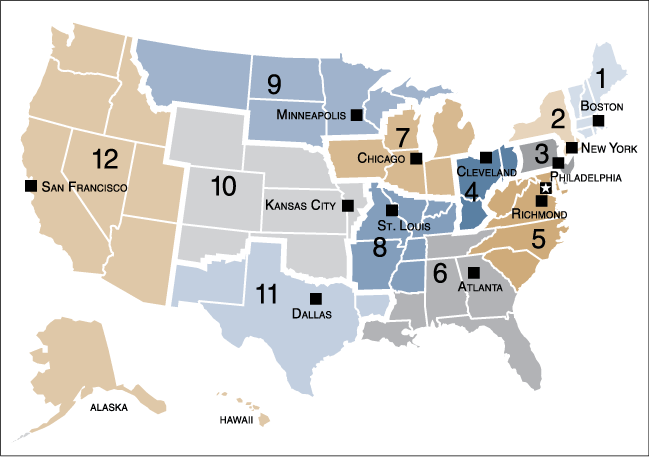
The Fed’s reserve bank system is comprised of twelve regional banks with 24 branches and serves as the operating arms of the Federal Reserve System. They are strategically located in large cities throughout the United States with staff tasked with identifying the perspective and context of their particular regions which then influences broader policy decisions set forth by the Fed.

The reserve banks generally have three main stakeholders – bankers (both regional and national), the U.S. Treasury, and the public. They are commonly referred to as bankers’ banks as one of their core responsibilities is to provide services to commercial banks to ensure smooth and stable operations and financial conditions. Each regional bank distributes coin and currency, lends money, and processes electronic payments for commercial banks in their region.

In addition, they serve as fiscal agents for the US government by maintaining accounts for the U.S. Treasury, processing government checks, and conducting government securities auctions. The regional reserve banks also conduct economic research on regional, national and international economic issues and conditions while also helping to prepare their presidents for participation on the FOMC (such information is contained in a publication referred to as the “Beige Book”). Their responsibilities are outlined below, all of which are critical to the smooth operation of the US financial system:

  • Lending money to member banks and other depository institutions through the ‘discount window’ where banks pledge collateral such as securities or loans against the amount they borrow (the value of which is determined by the respective federal reserve bank)***
  • Supervising and regular examination of member banks and their respective bank and financial holding companies ensuring soundness, stability and compliance – including enforcement of compliance with consumer protection and fair lending laws
  • Promote financial soundness and stability in support of local community development
  • Check collection and processing (almost solely electronic)
  • Provide publications and educational resources and research about the economy to the public

Make note, the Discount Rate tends to be set at the upper end of the Fed Funds Rate target range to encourage member banks to lend to each other, stimulating the previously mentioned free market participation and system liquidity with the discount window serving as a backstop rather than a primary source of funding and liquidity.


The Federal Reserve Open Market Committee (FOMC) – Cutting Through it All

Finally, we will wrap up on the Fed’s Open Market Committee (“FOMC”). The FOMC is the chief body for the Fed’s monetary policy and convenes for two days at a time during eight regular scheduled meetings throughout the year. At each meeting, a senior official from the Federal Reserve Bank of New York discusses financial market and foreign exchange developments and the activities of their trading apparatus which serves as the primary desk for buying and selling US government securities. Staff from the Board and the twelve reserve bank governors will present their findings and financial forecasts as they look to shape policy and find consensus whenever possible. The meeting structure provides a diverse set of viewpoints and information that is critical to the pursuit of the FOMC’s aforementioned dual mandate. Each meeting concludes with an announcement on the FOMC’s stance on monetary policy and a determination of the Federal Funds Rate and target range. That rate, often described as the “risk-free rate” in market parlance, is the target interest rate range established for overnight lending between banks lending to each other against their excess reserves. Primarily a proxy for government borrowing costs domestically, and even abroad, the rate also serves as the foundation for which all credit instruments are priced, to varying degrees, from commercial real estate and corporate debt to auto loans and mortgages. Rather than land on a single figure, the FOMC sets a range for policy rates allowing for a degree of flexibility, market forces and interbank system liquidity will generally result in a tight spread within that range. Once the policy range is set, the tools used to implement this policy include paying interest on reserve balances, overnight repos, and open market operations via the purchase and sale of

government securities. In essence, the responsibility of the FOMC involves navigating the implementation of Fed monetary policy into financial markets while limiting the overall frictions of doing so – a noble yet tricky pursuit. If their job was not difficult enough, on 4 separate occasions throughout the year, each member of the Board of Governors and each Federal Reserve Bank will provide their estimates of economic projections on a range of topics from GDP to inflation, the unemployment rate and where they believe the Fed Funds rate will be at various time intervals. These forecasts are not simply for the coming quarter or year ahead but for the next few years as well as the long run or “out years.” Acknowledging the incredible difficulty of prognosticating, especially something as complex as the US economy, the information’s value is to support the efforts around forward guidance which will spend some more time on our closing piece.


Conclusion and What’s Ahead

Having covered the various roles and responsibilities of the entities that comprise the Fed’s “holy trinity”, it’s clear just how wide of an aperture they must maintain when it comes to our complex adaptive economic system. As public servants, in what many described as a thankless job, their contributions to domestic, and by extension global, financial and economic stability are beyond immense. In our third and final piece, we will discuss Fed policy in greater detail as well as historic interventions and recent Fed policy actions and what the implications may be moving forward.


*More information can be found at https://www.stlouisfed.org/in-plain-english/federal-reserve-board-of-governors

**For more information on the Federal Reserve Banks visit https://www.stlouisfed.org/in-plain-english/introduction-to-the-federal-reserve-banks

***Eligible collateral includes commercial loans, real estate loans, corporate bonds, and government securities such as treasury notes and agency MBS

The views expressed represent the opinions of Breakwater Capital Group as of the date noted and are subject to change. These views are not intended as a forecast, a guarantee of future results, investment recommendation, or an offer to buy or sell any securities. The information provided is of a general nature and should not be construed as investment advice or to provide any investment, tax, financial or legal advice or service to any person. The information contained has been compiled from sources deemed reliable, yet accuracy is not guaranteed. Additional information, including management fees and expenses, is provided on our Form ADV Part 2 available upon request or at the SEC’s Investment Adviser Public Disclosure website, www.adviserinfo.sec.gov. Past performance is not a guarantee of future results.

Breakwater Team

At Breakwater Capital, we work with families across the United States, providing each client with a personalized experience tailored to their current circumstances, future goals, and timelines.


Read Other Posts By Breakwater
By Irshad Design Team December 10, 2025
Strategic gifting can reduce estate taxes and help loved ones when they need it most. Discover 2025 gift tax rules, state exemptions, and planning strategies.
By Irshad Design Team December 10, 2025
Most young workers lose thousands in unvested 401(k) matches. Learn the 5 vesting schedule types and how timing job changes can save your retirement.
three old white men in suits who look like businessmen standing in front of a federal building
November 20, 2025
Learn about the US Federal Reserve System's structure, history, and current leadership. Understand the Fed's dual mandate, FOMC meetings, and how Fed policy decisions impact investors and consumers.
October 13, 2025
Market outlook for Q4 2025: Fed rate cuts and strong earnings fuel gains, but elevated valuations, rising deficits, and speculative bubbles in gold and AI warrant caution. Learn what's ahead for investors.
October 8, 2025
Written by Madeline Barconi If you're one of millions of homeowners with a sub-3% mortgage rate wondering whether to renovate your current home or sell and upgrade to a bigger house, you're facing one of today's most challenging real estate decisions. Remember 2019–2021? We were all baking sourdough, learning TikTok dances, and, oh yeah, locking in 30-year mortgages at rates so low they now feel like unicorn sightings. If you were lucky enough to snag one of those sub-3% loans, congratulations, you basically married the George Clooney of mortgage rates. I’ll be the first to admit: this is something I personally wrestle with. My husband and I bought our house in 2020 with a shiny 2.99% mortgage, and at the time it felt like we hit the jackpot. Fast forward a few years, add our son into the picture (plus all the toys, gear, and chaos that comes with him), and suddenly everything feels… tighter. Now I find myself asking the same questions many of my clients do. Do I really want to give up a 2.99% rate for something closer to 6.25%? Or is it smarter to spend $80,000 on renovations to make this home work for us? And if I do sink that much into upgrades, is it worth it or would it be better spent on a new house entirely? If you’re nodding along, you’re not alone. Let’s break down the trade-offs between renovating vs. moving.  Option 1: Stay and Renovate Your Current Home The Upside The upside of home renovations , you keep that dreamy, low interest rate. (Seriously, people may envy you forever.) Renovating can cost less than moving once you factor in realtor fees, moving costs, elevated utility costs, standard maintenance and those “oops we need all new furniture” moments. You get to customize your home for you, not some random buyer in the future. The Downside The downside of major renovations rarely cost what you think they will (hello, HGTV plot twist). People often spend 20-30% more than what they think they will. Living in a construction zone is… let’s call it “character building.” Not all upgrades add value, hello $40,000 outdoor pizza oven that a future buyer might shrug at. Try not to put more than ~10–15% of your home’s current value into renovations unless you’re planning to stay there for the long haul. Otherwise, you risk over-investing in a property that won’t give you the return you want. Option 2: Sell and Buy Something New The Upside The benefits of selling your home : you get the extra space you actually need, whether that’s another bedroom, a home office that isn’t your closet, or a backyard big enough for the trampoline your kids are begging for. Sometimes starting fresh is easier than trying to rework a space that just doesn’t fit. If your income has grown since you first bought, this might actually be the right time to “trade up” despite the higher mortgage rates. The Downside The downsides of buying a bigger home: interest rates today are… well, let’s just say they aren’t George Clooney. They’re more like that guy from your twenties who your mom referred to as “fine” whenever you told her they were coming over for dinner. Monthly mortgage payments will likely be much higher, not just because of the rate, but because home prices have risen too. Selling and moving is a ton of work (and expensive). Realtors, inspections, movers, cleaning crews, new curtains and furniture, more upkeep, it all adds up. Be honest with yourself about affordability. A bigger house isn’t worth it if it means saying goodbye to vacations, kids’ activities, or simply sleeping at night without financial stress. The Middle Ground: How to actually Decide Between Renovating and Moving At the end of the day, it comes down to your numbers and your priorities. Ask yourself: How much more space do I actually need, and why? Could I make my current home work with a targeted renovation? If I move, can I comfortably afford the new payment including taxes, homeowners insurance (which continues to be one of the stickiest contributors to inflation), and maintenance without derailing my other financial goals? Am I okay with giving up my “unicorn” interest rate for more square footage and convenience? Final Thought You’re not alone if you feel “stuck” between a rock (tiny house) and a hard place (big mortgage). I’m right there with you, debating whether to live through the dust of a renovation or trade in a once-in-a-lifetime mortgage rate for more space and more comfort. The key is not to rush. Run the numbers, think about your long-term goals, and weigh how much joy (and sanity) more space would bring you. Sometimes the answer is obvious, and sometimes it’s just about deciding which kind of pain (financial or construction) you’d rather live with. Either way, the good news is you have options, and knowing the trade-offs is the first step to making the best home buying decision (or not) for you. The views expressed represent the opinions of Breakwater Capital Group as of the date noted and are subject to change. These views are not intended as a forecast, a guarantee of future results, investment recommendation, or an offer to buy or sell any securities. The information provided is of a general nature and should not be construed as investment advice or to provide any investment, tax, financial or legal advice or service to any person. The information contained has been compiled from sources deemed reliable, yet accuracy is not guaranteed. Additional information, including management fees and expenses, is provided on our Form ADV Part 2 available upon request or at the SEC’s Investment Adviser Public Disclosure website at www.adviserinfo.sec.gov . Past performance is not a guarantee of future results.
By Jeffrey Hanson September 18, 2025
It’s annual enrollment time and for those with a small business or buying health insurance privately or in your state’s marketplace, it’s a wonderful time to revisit whether or not a Health Savings Account is right for you. While many of us are acutely aware of the rising healthcare costs, according to a recent WSJ article the data suggests with an aging (and somewhat unhealthy) population it’s hard to see any relief on the horizon. So, what can you do aside from eating well, exercising and managing stress to limit your trips to the physician’s office and minimize how much money you spend on healthcare each year.  Here is something worth considering. First, let’s define a Health Savings Account (HSA). It is a tax-advantaged savings account designed to help individuals and families save for medical expenses whether for the year ahead, or better, for those expenses they’ll incur later in life. The account itself is paired with a high-deductible health plan (HDHP) which generally carry lower plan premiums as the insured (you) accept a little more of the financial responsibility for visits/treatments than traditional insurance. Here's how an HSA works and some key features:
By Breakwater Team April 28, 2025
Some financial pundits suggest that all you need for financial success is a “set it and forget it” approach with passive index fund investing. While long-term investing is indeed advantageous, is that truly all you need to do? What about tax-saving strategies, generating retirement income, or establishing a solid estate plan? And how should you respond to major life changes or significant market volatility? The simple fact is that managing wealth is complex, especially for high-net-worth individuals. From investment choices to tax planning and business succession, navigating these areas without professional guidance can lead to costly oversights. Partnering with a skilled fiduciary advisor can simplify the process, helping you focus on long-term success while steering clear of potential pitfalls. Breakwater Capital Group provides advanced wealth management solutions rooted in integrity and transparency. Our team of fee-only fiduciary advisors brings clarity and strategic insight to clients across the country.  This article explores the benefits of professional wealth management advice, highlighting the value of a fiduciary advisor who provides comprehensive and personalized financial solutions.
By Breakwater Team April 21, 2025
Spring is a time for renewal—a season to declutter, reorganize, and bring fresh energy into our lives. While cleaning out closets and tidying up your home, why not do the same for your finances? A cluttered financial situation can lead to stress, missed opportunities, and hidden costs that can throw off your long-term plans. Taking the time to organize your finances can help you feel more in control and ready for the future. With over five decades of combined experience, Breakwater Capital Group helps clients nationwide manage their assets, offering personalized guidance through our Massachusetts, New Jersey, and Colorado wealth management offices.  In this blog, we’ll explore why financial organization matters and the key steps you can take to refresh your financial life this spring.
By Breakwater Team April 14, 2025
Imagine you’re preparing for your retirement, anticipating enjoying the fruits of your labor. Then, you notice interest rates changing and fret about its impact on your savings and investments. Understanding these changes is crucial for maintaining the health of your finances.  Monitoring trends in the economy enables you to make smart choices and navigate transitions wisely. Rising and falling interest rates can impact several aspects of planning for your retirement, such as investment performance and the cost of borrowing.
By Breakwater Team April 4, 2025
…grant me the serenity to accept the things I cannot change, the courage to change the things I can, and the wisdom to know the difference. – Reinhold Niebuhr In a year that had already witnessed a noticeable uptick in volatility compared to the prior two years, the ongoing back and forth regarding looming tariffs, culminated in what has been described by many pundits as some of the most aggressive levies introduced since the 1890s. While the policy announcements themselves have been well telegraphed, the scope and scale are considerably higher than what was expected, as evidenced by the market’s harsh response. Rather than imposing tariffs based on pre-existing trade protections with our counterparties (i.e., existing tariffs, subsidies, or other barriers to entry) the formula to arrive at the tariffs focused more on the trade imbalance between the two nations. As the largest economy in the world, trading with nearly everyone, many of which are much smaller countries/economies, this was ripe for distortion. For those who have been long time followers of President Trump’s beliefs this should come as little surprise, a recent piece in the WSJ captures quotes dating back to the 1980s which share his perspective that the US was drawing the short straw and other nations should have to pay to access our robust and dynamic economy.  Going back to the days of the earliest trade when men roamed the earth hunting for food there has always been some degree of mercantilism whereby one group looks to accumulate power and wealth and protect their own interests, but in the Post World War II era, it’s inarguable that the US has benefited enormously from their embrace of “free trade” and capitalism. Our economy has grown a hundredfold since 1950 when it was approximately $270BB. The naysayers will point out that back then the US accounted for about 50% of global GDP, peak wealth, or about twice what it is today, but that fails to account for the fact that much of the world having fought the theatres of war in both Europe and the Pacific was in ruin and needing to be rebuilt. There is a misconception that both NAFTA (1994) and China’s entry into the World Trade Organization (2001) were the watershed moments leading to the hollowing out of the US’s manufacturing base, but in reality manufacturing employment had been in decline going back to 1950. At its peak US manufacturing workers accounted for about 30-35% of the nonfarm workforce, whereas today that level sits at around 8% where it has hovered for the last 15 years. In 2000 it was just 15% so still very much the minority. This long-term shift in the mix of the US economy where services now account for a disproportionate percentage of GDP and the workforce overall is the result of a far more skilled workforce driving both innovation and productivity. Surely some manufacturing jobs have left based on the focus on corporate profits, but some of the change relates to comparative advantage and inexpensive labor. It’s not to say, that we should look to push all manufacturing to the most “efficient” destination, surely it’s important to maintain control of manufacturing of critical components to defense, information technology or medicine, but it seems unrealistic at best to expect that we can produce enough and at reasonable costs to satisfy our insatiable demand. We are after all only about 5% of the world’s population, though we account for 25% of global GDP. Talk about punching above our weight. Aside from the logistical challenges that reshoring/onshoring pose, not to mention the timeline associated with the payback for such efforts, the willingness or lack thereof on the part of the business and consumers alike beg the question of whether or not it is worth pursuing. Considering our societal tendencies for policy to reverse course every 4-8 years with Washington’s constant changing of the guard which has grown even more partisan in recent years, it’s hard to envision the private sector making these investments where there may be little or no long-term benefit to the majority of stakeholders, mainly consumers and shareholders alike. If we are being intellectually honest, as we have seen with the likes of Amazon, if automation or robotics can do the work better than human beings, who need benefits and breaks, the case for this policy bolstering manufacturing employment seems weak at best. That’s one of the key pillars of the artificial bull case after all. In addition, there is clear evidence that economies which produce a disproportionate amount of goods versus services are much more susceptible to the boom bust cycle as demand for goods themselves is far more cyclical, look no further than Japan and Germany whose export driven economies have largely languished for the last 20 years in the slow growth/no growth period in the aftermath of the Great Financial Crisis. Let’s put all this into context, according to the World Trade Organization as of 2023 the US had a trade weighted tariff rate of 2.2% lower than nearly all countries around the world. For a country that is such a massive importer one might argue the low levels fostered healthy trade relations with some of our key allies and admittedly some frenemies or altogether poor bedfellows. With these sweeping tariffs, some as high as 49%, this marked a significant shift in policy where the aforementioned tariff rates will approach 30%, having a significant and lasting impact on consumers and businesses alike. Whether you want to describe a tariff as something different than a tax seems to be semantics, the added expense is rarely fully eaten by the producer. In the aftermath of the pandemic and the correspondingly high inflation due to excessive fiscal and monetary policy along with supply side disruptions, its doesn’t require too much detective work to know the average American is exhausted or outraged by higher prices. The tariffs will only add to the price at the register unless we all of a sudden find the private sector extraordinarily benevolent, willing for much if not all of the added costs to result in shrinking margins. By now you have surely figured out why there was such a market kerfuffle, but let’s make sure to fully examine why the result was to shave $3 trillion of market value off of US stocks in one day, which supposedly is the equivalent of 5 years’ worth of tariff receipts. First and foremost, despite opening the year with an economy bumping along with real GDP around 2.50% we have seen a sharp decline in the soft data, where surveys from the confidence board and University of Michigan plumb levels we have not seen going back to the pandemic when fears of a severe respiratory infection and 10% unemployment were front of mind. The hard data has been only a little better as labor has held up thus far, but as we have seen in Retails Sales there are signs that the consumer may be tapped out or growing wearier. With GDP likely to be between negative .5% to positive .50% for Q’1 that it’s like slamming on the brakes while driving in the passing lane. No surprise that there may be a real sense of whiplash. As the odds of a recession have risen, something the President himself acknowledges, it’s safe to assume expectations for earnings growth this year and next seem to be slipping away. With valuations stretched, there has been little margin for error and it’s those stocks, some of the most expensive that have felt the impact that much more acutely. This is why we have heard the “Mag 7” referred to as the “Lag 7” here in early 2025. Now you might be thinking this is likely transitory, a word that is making its rounds again after an ill-feted debut to Wall Street vernacular in 2022. If we are in fact, we are likely to see a shift to a more capital-intensive economy, is it reasonable to justify such high multiples which made more sense in an asset light, intangible heavy ecosystem? It seems hard to justify, from this vantage point. Hopefully, we will avert a recession, but that’s not to say it is an all-clear sign for the stock market. Earnings recessions, like that of 2022, may not lead to large scale job losses and disinflation, but increase the prospects for a bear market. There is a risk here that those fat margins whither because of trade frictions and lead to something more pernicious like a repeat of the stagflation episode of the 1970s and early 1980s where higher inflation sucks the oxygen out of the room leaving little room for real growth. So, what is an investor to do… Well for one thing, maintaining discipline in the form of diversification has helped and likely will continue to, with investors who have roughly half of their portfolio in overseas stocks and fixed income, the positive returns in these two areas have been able to offset some of the decline in US stocks. Incorporating other assets like Treasury Inflation Protected Securities (TIPs), gold or real estate may help mitigate the risk somewhat but as we have seen in the past times of market angst correlations often increase, giving the appearance there is no place to hide. Eventually markets will calm down, as the last of the sellers capitulate, though that process can take weeks or even months to play out. I’ll leave you with some quotes from some of the smartest minds on Wall Street to ponder as we head into the weekend. “Sometimes the share price of a firm tells the CEO of that firm nothing about their company they didn’t already know. Other times, the stock market takes on the role of “active informant.” Stock prices predict investment because they provide business managers with useful information about the future. I think now is probably one of those times. -Neil Dutta, Head of Economics, Renaissance Macro “We all know the math: the stock market has historically grown by 10-11% over the long run but only gone up 60-70% of the time. That means it has corrected 30-40% of the time. Surviving those drawdowns is the price of admission.” -Jurrien Timmer, Director of Global Macro at Fidelity Investments “We are a great nation, the leader of the free world. Yet we squander our political power to appease the textile industry in the Carolinas! We should instead be setting a standard or the world by practicing freedom of competition, of trade, and of enterprise that we preach. -Milton Freidman This presentation is not an offer or a solicitation to buy or sell securities. The information contained in this presentation has been compiled from third-party sources and is believed to be reliable; however, its accuracy is not guaranteed and should not be relied upon in any way whatsoever. This presentation may not be construed as investment, tax or legal advice and does not give investment recommendations. Any opinion included in this report constitutes our judgment as of the date of this report and is subject to change without notice. Additional information, including management fees and expenses, is provided on our Form ADV Part 2 available upon request or at the SEC’s Investment Adviser Public Disclosure website, www.adviserinfo.sec.gov. Past performance is not a guarantee of future results.